
An interview in the “Dwarslaesie Magazine”, from the Dutch Paraplegia Association (Dwarslaesie Organisatie Nederland – DON)
A spinal cord injury can bring many additional complications that affect each person differently. In this column different people tell us their story.
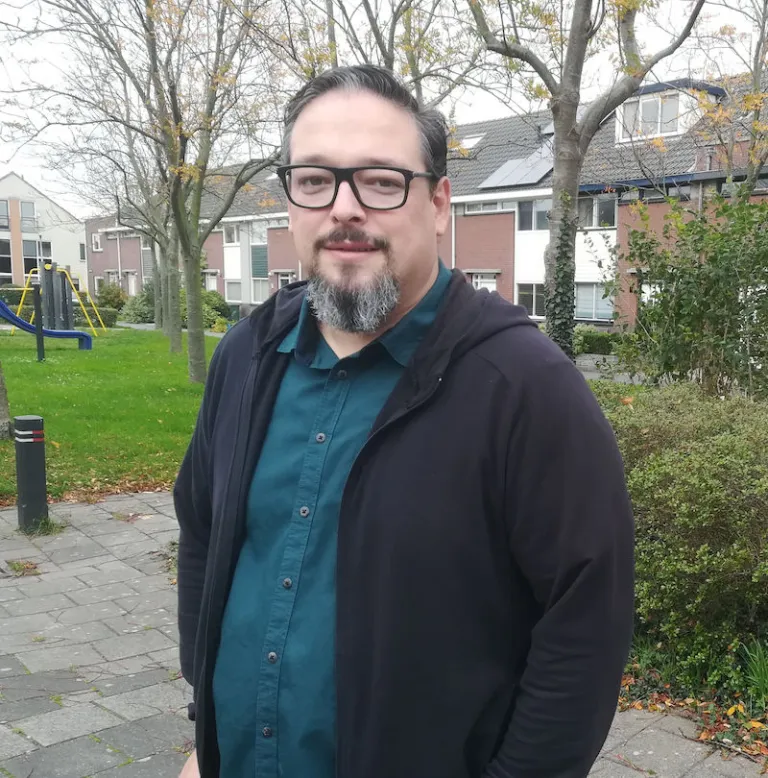
For me, the consequences for my loved ones are the worst.
The injury
Lucas Vieites: ‘I have a Cauda Equina Syndrome, located between the L5-S1 vertebrae, caused by an acute disc herniation I suffered three and a half years ago. I was 40 years old and my life, and my family’s, were suddenly turned upside down. My wife, son, and I had moved to the Netherlands three years earlier and were still settling in. While the Netherlands is familiar to me because I was raised here until the age of 15, my wife and son were in a strange country with an even stranger language. Under these circumstances, a blow like this lands extra hard.’
The consequences
‘After three months of intensive rehabilitation I was walking with crutches, and currently I get along quite well with just a walking cane. I still have issues with the removal of bodily waste (a recurring topic among those of us who suffer any kind of paraplegia). For example, I use disposable catheters daily, and there’s an absence of urge when I need to poop. I am still working full-time, though, but any activity that requires walking or standing for long periods of time are hard to do or impossible. The worst for me are the consequences for my loved ones. I still feel a lump in my throat when I see a father playing with his child in a way I no longer can, for example, going for a bike ride, or kicking a football. My wife was especially affected by the consequences, and these were difficult times for her. Instead of a husband who should be a support, she found herself with a husband she needed to help and care for. I think it’s very important that there’s attention on the partners, during the rehabilitation, as well as afterwards. Fortunately the DON organizes partner meetings for those who want to assist.’
Reactions
‘I work for a large company and when I’m at the office I often get to hear how nice it is that everything turned out right, or that I’ve had so much progress. But when I went to work in shorts last summer, during a heat wave, I got the questions: “What happened to your legs?” and “What are those braces for?”. It’s hard to quickly explain the issue is not in my legs, but in my back. I wear those braces so I literally don’t stumble over my own feet. I have actually been wearing them for the last three years. The reaction is: “I though you walked a bit funny, but didn’t know it was that bad”. At the office you also don’t tell much more. People don’t want to know that you can’t poop or pee normally, let alone have intimate relationships. You can walk, right?! A few years ago, Corné Ouburg wrote a short piece titled “Imagine…“. In it, he lists the invisible consequences for people who are bound to a wheelchair, as well as for those of us who can walk. I translated the text to English and have it pinned to my cubicle wall so people can read it. Whenever I see someone stop and have a look, I usually catch a glimpse of better understanding in their eyes.’
Life, now
‘”What I want, is to go on with my new life.” That’s one of those phrases you hear a lot when in rehabilitation, but you only really understand its full meaning until much later. Admittedly, it took me a few years. There is a life after paraplegia, just a different one. There are many things you will have to adapt and you can’t do everything any more, but there’s a lot that you can do. I regularly play frisbee with my son now, and I’ve found a new interest in videogames (which I never had before). I’m also trying to figure out how to get back on a windsurfing board, which is something I haven’t done for a long time, and used to enjoy very much. After my rehabilitation, I became a volunteer, impressed by the good work of the practitioners and the DON: I’m a member of the website editorial team and contact person for my rehabilitation centrer. Little by little, new possibilities appear. Luckily there are so many other things you can do and do differently.’
More:
- A year of rehab (learning to walk again) – [YouTube]
- Original article (in Dutch) [PDF]
Author: Lucas Vieites ✦ Published: ✦ Updated: ✦